


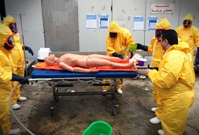
 WHO and OPCW–UN joint mission have been working closely to reinforce public health capacities to respond to the risks of chemical incidents. Photo credit: WHO\Syria15 April 2014, Damascus – The Organisation for the Prohibition of Chemical Weapons (OPCW)–United Nations Joint Mission and the World Health Organization (WHO) have been working to strengthen public health capacities within the Syrian Arab Republic to respond to risks of chemical exposure.
This collaboration is part of WHO’s existing programme to strengthen the Syrian Arab Republic’s health system’s ability to manage and respond to chemical accidents and mass casualty incidents involving toxic chemicals.
In cooperation with the Syrian Ministry of Health, and with financial support from the OPCW-UN Joint Mission, WHO procured chemical personal protective equipment for hospitals and health responders in the Syrian Arab Republic and conducted an advanced training course for emergency physicians in February 2014.
To further build the capacity of health personnel in responding to chemical incidents, WHO and the Ministry of Health of Syria are currently training staff from Syrian hospitals on personal protective equipment, emergency decontamination of patients, and life-saving clinical care.
Within the framework of UN Security Council Resolution 2118 (2013), WHO and the OPCW-UN Joint Mission share a common interest in assigning the highest priority to public health issues during the movement of chemical material from the Syrian Arab Republic.
Further to the letter of the Secretary-General to the President of the Security Council dated 7 October 2013 (S/2013/591) and in accordance with Security Council Resolution 2118 (2013) and the relevant decisions of the OPCW Executive Council, the OPCW-UN Joint Mission has engaged extensively with WHO on public health aspects related to the elimination of the chemical weapons programme in the Syrian Arab Republic.
Organisation for the Prohibition of Chemical Weapons (OPCW)–United Nations Joint Mission
For more information, please contact:
Karim Shukr
Communications Officer
WHO Country Office - Syria
Direct: +963 11 3315053
E-mail: